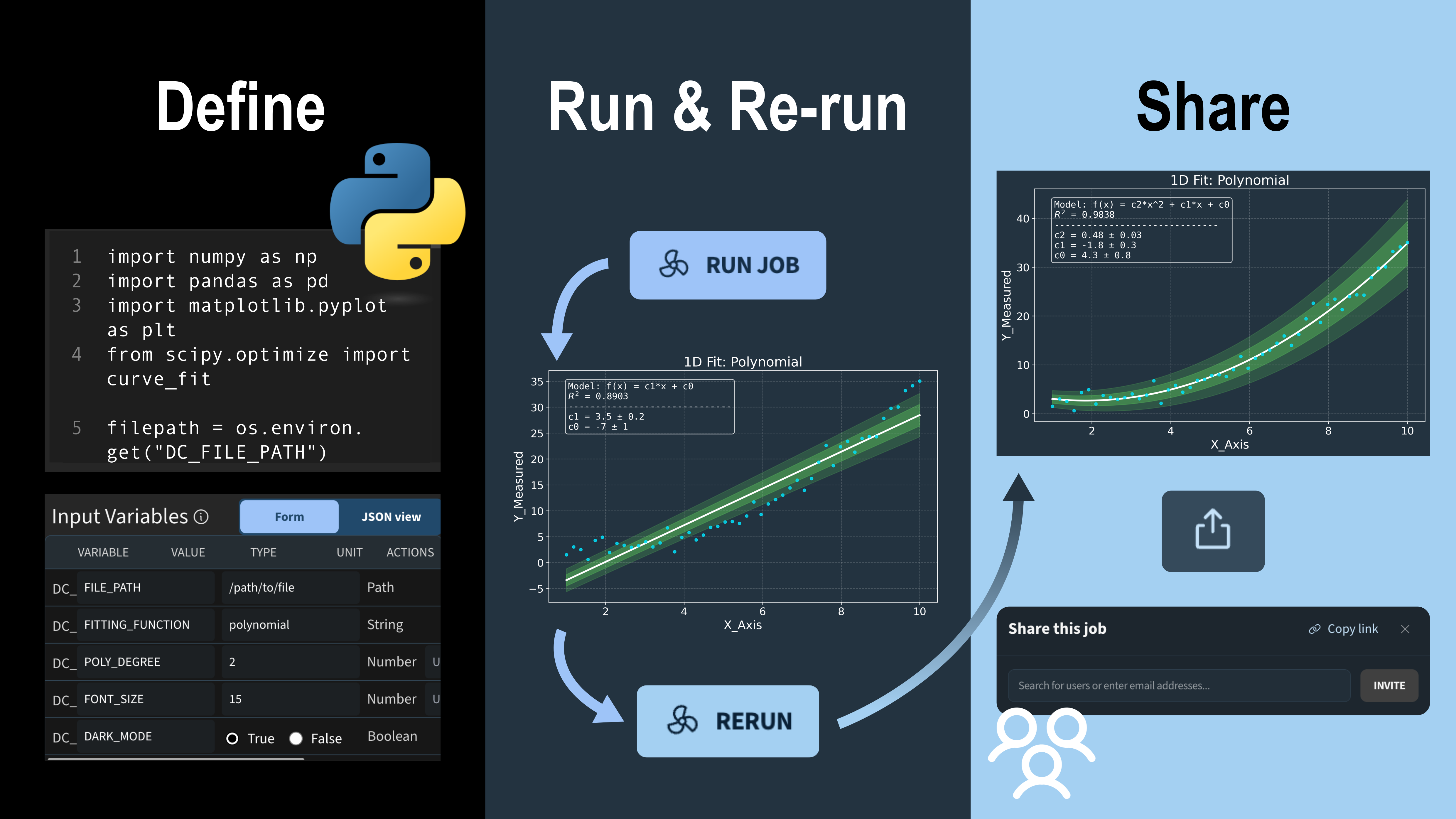
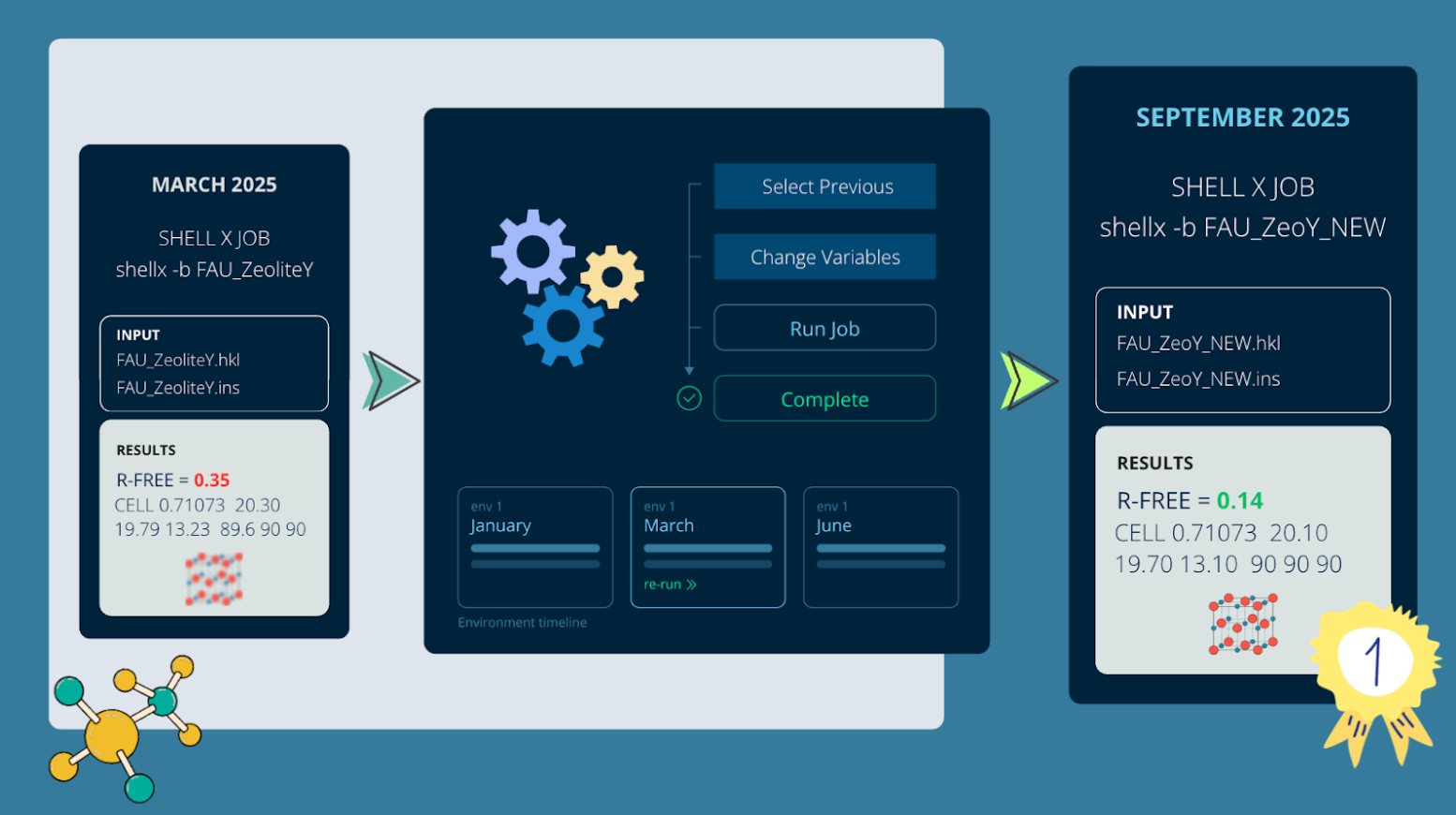
DECTRIS CLOUD is designed for iterative scientific workflows, with built-in run and re-run job capabilities. Users can run jobs, inspect results, and re-run the same job with updated parameters without losing track of what happened. All iterations are automatically grouped in a job history, making it easy to compare results and understand how outcomes evolved.
What “run & re-run” enables
DECTRIS CLOUD captures the full context of every execution so you can confidently iterate:
- Run jobs from analysis templates (e.g. unpacking a dataset, processing diffraction images
- Inspect job details at any time: inputs, parameters, logs, outputs, and resource usage
Re-run jobs with modified parameters in a couple of clicks — creating a new job rather than overwriting the old one - Track iterations via Job History, which groups the original job and all re-runs into one comparable view
This means you can experiment safely: try defaults first, review outcomes, adjust parameters, and keep a clear record of every attempt.
Why it matters for reproducible science
Scientific analysis is inherently iterative. Parameters evolve, assumptions are tested, and results improve through refinement. DECTRIS CLOUD is built to support this reality by ensuring that every run is traceable and every decision is preserved.
Instead of duplicating data or manually tracking changes, users can focus on the science, knowing that the platform automatically records how a result was produced, not just what the result was.
Designed for real workflows
Run and re-run capabilities integrate with project-based data management:
- Jobs operate directly on project data without copying files
- Failed runs remain visible and inspectable for learning and debugging
- Multiple iterations can run independently or in parallel
- Results can be revisited, shared, or reproduced at any time
The result is a workflow that encourages exploration while maintaining clarity, accountability, and confidence in the outcome.
![Transition from raw detector images to electron density maps and refined atomic models in Coot. Depicted data is from the 7QNP dataset [14]. The 3D molecule rendering has been produced with the Render Molecule job template, which utilizes the MolecularNodes Blender plugin developed by Brady Johnston.](https://cdn.prod.website-files.com/670f957a3be26367c038245d/69c698806079c5f5265daa1a_thumbnail_v3%20(1).png)